
Key Takeaways
- Financial advisor value propositions can rely on similar language around holistic planning and client-first service, which can make it difficult for prospects to differentiate firms.
- A value proposition becomes tangible when substantiated with objective portfolio evidence showing a prospect a clear analysis of their own held-away assets, including fees, risk, and allocation.
- Consistent delivery can strengthen the credibility of a value proposition, and a repeatable acquisition workflow that advisors across the firm can execute is one way to support it.
- For enterprise firms, firmwide governance over analytics and reporting can contribute to a more consistent client experience across teams and offices, reinforcing the value proposition at an organizational level.
- Firms can refine their value proposition over time by analyzing engagement signals, such as which elements of a prospect meeting prompt the most questions and follow-up conversation.
Advisory firms can encounter a messaging challenge when their value proposition relies on familiar language such as holistic financial planning, personalized service, and a client-first approach. These claims are not wrong, but on their own they often do little to set one firm apart when similar language appears elsewhere in the market. One challenge firms can face lies in the gap between what they say and what a prospect can actually observe during their first few interactions. A well-crafted statement of value carries more weight when the experience of meeting with an advisor feels clear, consistent, and specific to the prospect.
A credible financial advisor value proposition depends on more than better adjectives or more aspirational messaging. It becomes more meaningful when it is substantiated by objective portfolio evidence and delivered through a repeatable process. It is the difference between telling a prospect you offer data-driven guidance and showing them a clear, consolidated analysis of their own holdings. This article explores how advisory firms can bridge the gap between their stated value and their delivered value by grounding their claims in the operational work behind the advice, moving from abstract promises to observable proof.
Why Financial Advisor Value Propositions Often Sound Alike
Advisory firms can find themselves using similar vocabulary because services such as comprehensive planning, investment management, and fiduciary care genuinely overlap. The issue is not a lack of integrity but a convergence of language. Over time, phrases that once set a firm apart can come to describe the category rather than any one firm. This creates a challenge for firms that want to demonstrate their unique value, not just state it.
The Language Convergence Problem
When messaging relies on generalities like 'holistic planning,' 'personalized service,' and 'putting clients first,' it can be difficult for a prospect to form a distinct impression of any one firm.
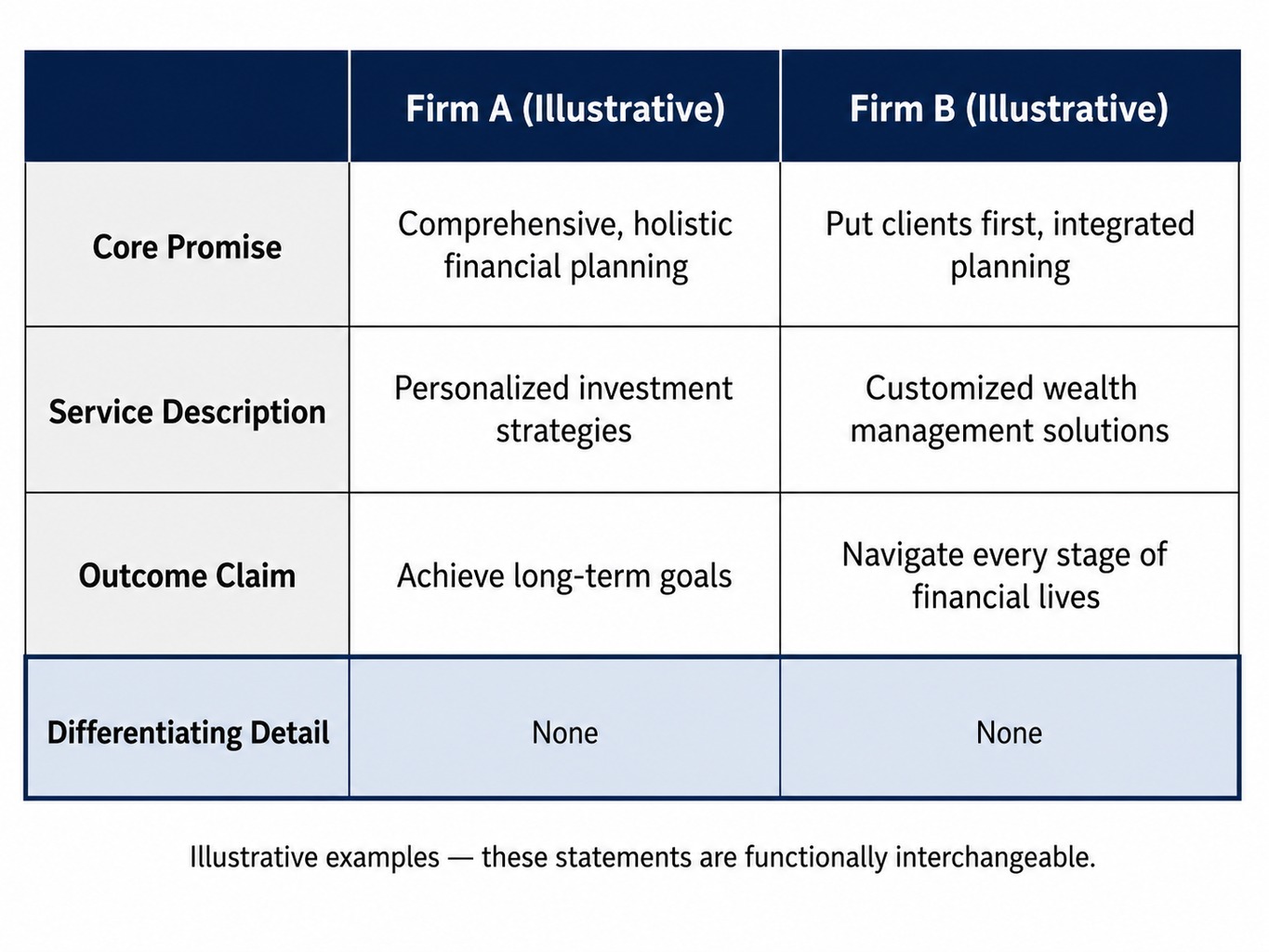
Consider these two illustrative value proposition statements:
- Firm A: "We provide comprehensive, holistic financial planning and personalized investment strategies to help our clients achieve their long-term goals with confidence."
- Firm B: "Our mission is to put clients first, delivering customized wealth management solutions and integrated planning to navigate every stage of their financial lives."
While the words differ slightly, the underlying promise is functionally identical. If a prospect could copy a firm's value proposition and paste it onto a competitor's website without anyone noticing, the language would not yet be doing the work of differentiation. The path forward is not necessarily finding new words, but finding new ways to prove the words a firm uses are meaningful.
The Gap Between What Firms Say and What Prospects Experience
Even a well-articulated financial advisor value proposition may be less differentiated if the prospect's early interactions do not reinforce it. A value proposition is not just a statement; it is also a promise, and the firm's workflow is one important factor in whether a prospect's early interactions reinforce or weaken it. Firms can strengthen this connection by aligning the category of evidence they present with the specific claim they lead with.
Imagine a firm that claims to provide 'objective, data-driven guidance.' If the initial prospect meeting consists of a verbal walkthrough of the firm's philosophy and a discussion of market trends with no portfolio-level evidence, the prospect hears the claim but has less tangible evidence through which to evaluate it. The conversation remains abstract, and the firm has fewer concrete ways to demonstrate how that analytical approach shows up in practice.
How Portfolio Evidence Can Substantiate Your Value Proposition
One tangible way to substantiate a value proposition is to provide prospect-specific portfolio analysis. Bringing prospect-specific portfolio analysis into an early-stage prospect conversation can give the value proposition clarity and substance within the relationship. When an advisor can take a prospect's existing statements, extract the data, and present a clear analysis of allocation, risk, fee structure, and tax considerations, the firm's value proposition can begin to feel less like a claim and more like an observable experience.
This process bridges the gap between messaging and delivery. It moves the conversation from the advisor's philosophy to the prospect's reality. The ability to produce that evidence quickly and consistently gives advisors a clear, objective foundation for the advice conversation. Platforms like VRGL are designed to support this workflow, enabling advisors to prepare and present objective analysis without replacing their own judgment.
Turning Held-Away Assets into a Proof Point
Held-away assets can provide an opportunity to demonstrate analytical value during the prospect experience. When an advisor can quickly convert raw statement PDFs from multiple custodians into structured data and present a consolidated view, the prospect has a concrete way to observe the firm's analytical capability.
Consider a hypothetical prospect who might hold accounts with their primary advisor, a 401(k) from a previous employer, and a small brokerage account they manage themselves. In this scenario, they may not have a consolidated view of their total household portfolio, including a blended view of asset allocation, overlapping positions, diversification gaps, and layered fees. An advisor who could produce this analysis during an early-stage conversation could provide the prospect with a consolidated view of those investment accounts and exposures. The conversation would no longer be about what the advisor could do; it would be about what they have done with the prospect's own information. This act of providing objective insights on what a prospect already owns can serve as a tangible demonstration of the firm's value.
Connecting the Analysis to the Acquisition Workflow
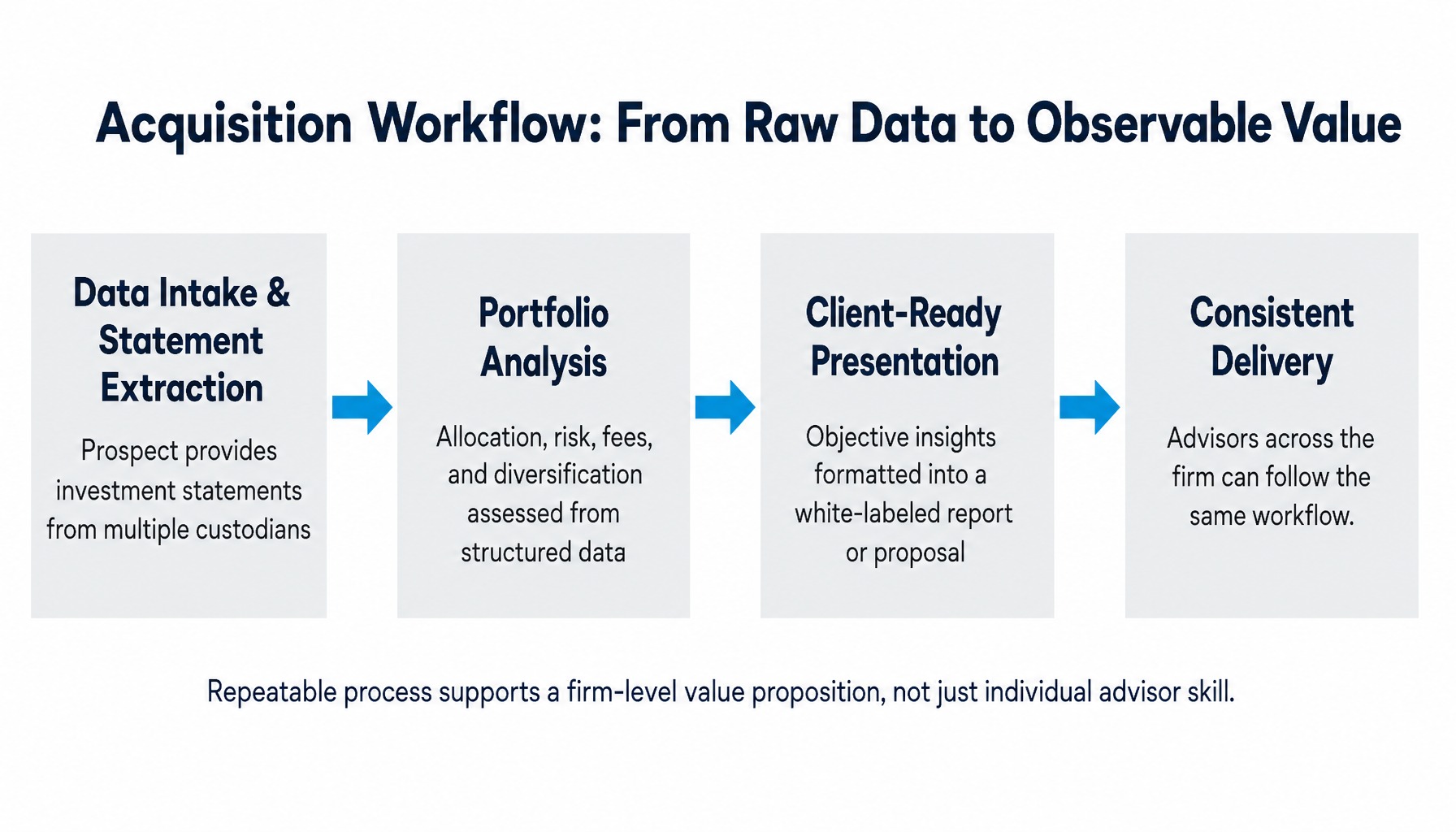
A single impressive analysis is only a starting point. A value proposition is also shaped by whether the process behind it is repeatable across the firm, alongside the strengths each advisor brings. When the analytical experience varies significantly across advisors, the firm's value proposition may also be experienced differently across prospect interactions. A structured acquisition workflow can help address this by giving every advisor a shared process for producing that analysis.
From a firm's perspective, an acquisition workflow is the defined path a prospect relationship follows from gathering the prospect's information, through portfolio analysis, to a client-ready presentation. Documenting this path helps give prospects a similar baseline experience that reflects the firm's core value proposition. Proposal generation becomes just one component of this broader system of work, which turns the abstract promise of 'data-driven advice' into a reliable, documented firm capability.
Read more: Three Tips for Creating Clear Client Proposals | VRGL
How Firmwide Consistency Can Help Strengthen a Wealth Management Value Proposition
For firms with multiple advisors, teams, or offices, consistency in how the wealth management value proposition is delivered can become increasingly important. For example, a prospect who meets with one advisor and receives a polished, data-backed presentation, then is referred to a colleague at the same firm who offers only a verbal overview, may encounter a meaningfully different experience of the firm's analytical approach.
Consider a hypothetical enterprise wealth firm with offices in multiple regions. In this example, two advisors in different cities might present materially different analyses to prospects with nearly identical portfolios. One advisor might pull data into a spreadsheet for a custom comparison, while another might use a templated slide deck with no prospect-specific data. While neither approach is necessarily wrong, the prospect experience would differ noticeably, and the firm's value proposition could come across differently depending on which advisor a prospect happened to meet. Consistency is not about rigidity; it is about establishing a shared analytical and presentation baseline that can reinforce the firm's brand promise in every interaction.
Governance That Supports Consistency Without Restricting Advisors
Technology and workflow design can help firms balance consistency with advisor autonomy. The operational goal is not to create uniformity by forcing every advisor to use the same script. Rather, it is to standardize the analytical framework and disclosure layer while leaving room for the advisor to contextualize the output.
A governance framework can help the analytical foundation, disclosure standards, and presentation quality meet a firm-level baseline. Depending on the tools a firm uses, this may involve elements such as standardized templates, firm-approved disclosure language, and a shared library of firm models and analytics. Within this governed framework, advisors can still personalize their conversations, choose their emphasis, and adapt the narrative to individual client needs. This approach allows governance and advisor autonomy to coexist, giving advisors a consistent foundation to build on.
Testing and Refining Your Value Proposition Over Time
A firm can treat its value proposition as something to test and refine over time based on prospect and client signals. Rather than writing a value proposition once and revisiting it only during a strategic retreat, firms can use observable signals from their own acquisition and engagement workflows to evaluate whether their stated value proposition aligns with what actually resonates in practice.
One operationally useful signal to consider is which proof points are associated with prospect engagement and progression through the acquisition process. Signals firms can track include:
- Engagement Points: Which elements of a prospect presentation generate the most follow-up questions? If prospects consistently focus on fee analysis rather than asset allocation, that may indicate where their perceived value is concentrated.
- Conversion Patterns: Do proposals that include a consolidated analysis of held-away assets show different engagement or conversion patterns than those that do not? Tracking this can help firms evaluate whether specific deliverables are associated with different outcomes.
- Client Feedback: Do recurring client reviews or surveys reveal patterns that align with or contradict the firm's stated value proposition?
Investing in operational visibility across these workflows can help firms see which parts of their analysis prospects find most informative, so the value proposition evolves with evidence rather than periodic brainstorming alone.
How VRGL Supports the Workflow Behind Your Value Proposition
A financial advisor unique value proposition gains strength from the firm's ability to substantiate it with evidence and deliver it consistently. VRGL is designed to help firms connect what they communicate about their analytical approach with what they can demonstrate during the acquisition process. The advisor's own discovery and fact-finding conversations remain the starting point; VRGL's analytical workflow begins once the prospect has shared their statements and the advisor is ready to analyze them.
The VRGL Growth Platform is designed to help firms move from raw prospect data to objective insights efficiently. With VRGL Core , advisors can use automated statement extraction to convert prospect investment statements into structured data for analysis. From there, they can run portfolio analytics on areas such as allocation, risk, fees, and diversification to build a clear, objective picture of a prospect's current situation.
These objective insights are then used to generate white-labeled proposals and reports that present the firm's analysis in a clear, client-ready format. For enterprise firms, VRGL offers governance capabilities designed to support a consistent client experience across advisors and offices.
From Aspirational Statement to Operational Reality
Ultimately, a financial advisor value proposition is as much an operational challenge as a copywriting one. Showing prospects objective portfolio evidence during the acquisition process, delivering that experience consistently across advisors, and refining messaging based on what resonates are all ways a firm can make its differentiation visible. Supportive infrastructure, alongside clear language, can contribute to that effort.
From VRGL's perspective, that operational work deserves the same attention as the messaging itself.
This article is for informational purposes only and does not constitute investment, legal, tax, or compliance advice.
Frequently Asked Questions
1. What is the difference between a value proposition and a positioning statement for an advisory firm?
A value proposition articulates the specific benefit a client receives, answering "Why should I hire you?" A positioning statement defines the firm's place in the market relative to competitors, answering "What kind of firm are you?" The value proposition is client-facing and outcome-oriented, while the positioning statement is strategic and market-oriented. Both inform each other but serve different functions in a firm's messaging architecture.
2. How can a firm build a value proposition around a repeatable process rather than individual advisor expertise?
Firms can shift the emphasis from "our advisors are experienced" to "our process supports a consistent analytical experience." This involves documenting the acquisition workflow from data intake through analysis to presentation and ensuring every advisor uses a shared analytical foundation. The reliability and quality of the firm's system of work then become an important part of the value proposition, complementing the expertise of individual advisors.
3. How do RIAs differentiate their value proposition from wirehouses and broker-dealers?
Firms can differentiate beyond structural or regulatory characteristics by demonstrating how their analytical process and client-engagement workflow operate in practice. Rather than relying only on category-level distinctions, a firm may choose to show how it gathers portfolio data, evaluates holdings, organizes observations, and presents those findings in a clear client-ready format. Showing a prospect an objective, multi-layered analysis of their current portfolio, for example, can help make the firm's approach observable within the prospect experience.
4. What considerations may shape a value proposition for high-net-worth prospects?
One consideration is the operational complexity involved in serving high-net-worth households. A value proposition may need to reflect how the firm handles multi-account portfolios, concentrated positions, entity structures, household-level reporting, and coordination with other professionals. In that context, the ability to present a consolidated view of assets and exposures, along with a clear process for organizing and communicating analysis, can become an important part of how the firm's capabilities are understood.
5. When might an advisory firm revisit its value proposition?
There is no fixed cadence, but firms may benefit from evaluating their value proposition whenever they notice shifts in prospect engagement, client feedback, or competitive positioning. Rather than treating it as a static, annual exercise, firms can use signals from their own acquisition and engagement workflows such as which presentation elements generate the most prospect interest to inform ongoing, evidence-based refinements to their messaging and service delivery.